
B.Sc. in Field Crops
Program Profile
The main focus of the Field Crops program is to equip students with comprehensive knowledge and practical skills in sustainable field crop production, highlighting the efficient management of field crops. The program covers various areas such as crop production, breeding, soil fertility, irrigation, pest management, and post-harvest practices. Graduates are trained to address challenges in agricultural productivity, employ modern techniques for crop improvement, and adapt to environmental and market demands, preparing them to contribute effectively to the agricultural sector in both practical and research capacities.
Occupational profiles of graduates
The Field Crops Department typically prepares students for careers related to the cultivation, management, and optimization of crop production. Graduates from this program are equipped with knowledge and skills that apply to various agricultural roles in both general and private Sectors. Here are some common job types they may pursue:
Agronomist – Specializes in crop production, soil management, and plant breeding. Agronomists work with farmers to improve crop yields and sustainable practices.
Crop Consultant – Provides advice on pest management, irrigation, fertilization, and crop rotation to enhance productivity and sustainability. (In private sectors)
Farm Manager – Oversees the daily operations of a farm, managing crop planting, harvesting, labor, and equipment.
Seed Technician or Breeder – Involved in the development and production of new crop varieties, improving resilience, yield, or disease resistance.
Agricultural Extension Officer – Works with farmers to provide education and practical guidance on modern farming techniques, crop protection, and sustainable agriculture.
Researcher in Crop Science – Conducts studies to understand crop physiology, genetics, and pest resistance, often working with agricultural research institutions or universities.
Pest Management Specialist – Focuses on controlling and managing pests that affect crops, ensuring healthy yields and environmental safety.
Agricultural Policy Analyst – Works with government bodies or NGOs to develop policies that affect crop production, agricultural sustainability, and food security.
Qualification awarded
B.Sc. in Agricultural Sciences in Field Crops
Length of programme
4 years (8 semesters)
Number of credits
240 ECTS credits
Mode of Study
Full time on campus
Program Educational Objectives (PEOs)
The Field Crops Department aims to develop and improve agricultural crop production by qualifying specialized personnel, conducting scientific research, and applying modern technologies to increase productivity and achieve agricultural sustainability. The detailed objectives of the Field Crops Department include:
Prepare graduates with a strong foundation in field crop sciences — including soil science,
crop physiology, plant breeding, biotechnology, and pest management — to solve agricultural problems and improve crop productivity in diverse environments.
Develop professionals capable of applying engineering, ecological, and technological principles to manage agricultural systems sustainably, with expertise in agricultural machinery, irrigation, surveying, agroecology, GIS, and sustainable land use and seed technology.
Equip students with communication, analytical, and research skills to contribute to agricultural development, extension services, entrepreneurship, and further studies through experiential learning, statistical analysis, and applied projects.
Read more about the programme
Get detailed information about the programme requirements, courses, credits, and educational objectives as a PDF file.
Program Learning Outcomes
- After successfully completing this programme, students should have an ability to:
- Demonstrate comprehensive knowledge of field crops production, including physiology, genetics, soil science, breeding, and biotechnology.
- Understand the principles of agroecology, sustainable agriculture, and environmental protection in relation to field crop systems.
- Understand economic, social, and policy dimensions of agriculture.
- Analyze data from agricultural experiments and apply statistical and experimental design techniques.
- Diagnose and solve field crop production problems using critical thinking and evidence- based approaches.
- Apply technical and practical skills in field preparation, planting, irrigation, harvesting, and machinery use.
- Conduct field and laboratory experiments and interpret results for crop improvement and soil-crop interactions.
- Work effectively in multidisciplinary teams and demonstrate leadership and responsibility in field-based tasks to engage in lifelong learning, critical reflection, and continuous professional development.
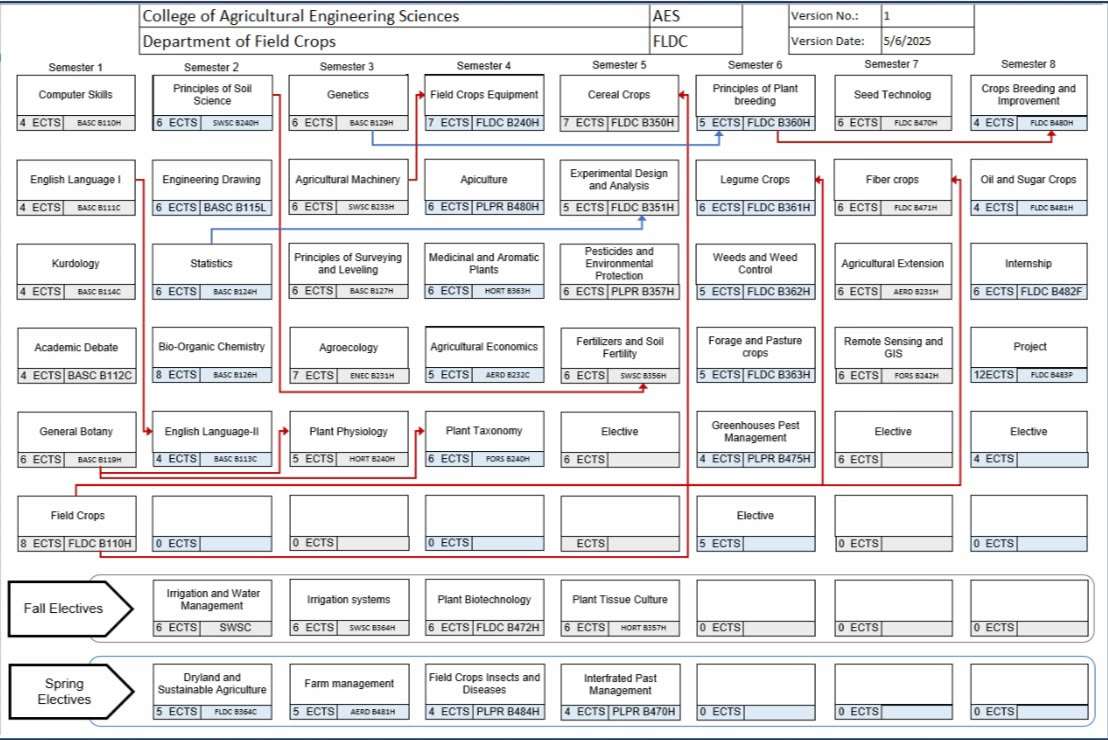
Programme structure diagram with credits
Yearly Timeline
Sept. 1, 2026
⚠️ First year students start around mid-October
⚠️ First year students start exams around 20 of January
July 1, 2027
Check out the full academic calendar on UoD's webstie.
Programme Coordinator

Assistant Professor in Field Crops (crops breeding and improvement)
Field Crops
College of Agricultural Engineering Sciences
University of Duhok
Apply to the Programme
Public undergraduate admissions in the KRG region are managed centrally by the Ministry of Higher Education through the online ZankoLine portal (regayzanko.com). After Grade 12 Baccalaureate results are released, high schools provide students with unique login credentials to rank their preferred universities and B.Sc. majors during a 10–14 day registration window. Final placement is automatically determined by the student's Grade 12 average, subject choices, and department capacity.